Why People with ADHD Struggle with Decision-Making (And How Ohio ADHD Therapy Can Help)
Mind Trek Counseling LLC | Expert ADHD Therapy in Cleveland Heights, Ohio
📍 Serving Ohio Residents at:
2460 Fairmount Blvd Suite 209, Cleveland Heights, OH 44106-3125
📧 info@mindtrekcounseling.com
The Hidden Struggle No One Talks About
You've been staring at your screen for 45 minutes.
Two emails to respond to. One project to start. Three options for dinner. None of them are life-or-death decisions—yet your brain is completely frozen.
If you have ADHD, this isn't a personality flaw. It's not laziness, stubbornness, or lack of willpower. It's a neurological bottleneck rooted in how your brain processes information, evaluates rewards, and perceives time.
At Mind Trek Counseling LLC, we help adults across Ohio understand their ADHD brain—and build systems that turn decision paralysis into confident action.
Why ADHD Makes Decision-Making So Exhausting: The Neuroscience
Decision-making is orchestrated by the prefrontal cortex—the brain's executive command center. In individuals with ADHD, this region shows:
Slower developmental maturation
Reduced dopamine and norepinephrine activity
Weakened connectivity to other brain regions
Here's what that looks like in everyday life:
1. Working Memory Overload
Your working memory is like a mental whiteboard. In a neurotypical brain, it can hold 4–7 items simultaneously. In the ADHD brain, that capacity shrinks significantly.
Real-world impact: You compare Option A and Option B. By the time you re-read Option B, you've already forgotten the details of Option A. So you re-read Option A. Then you forget Option B again. This loop drains your energy without moving you forward.
The therapy connection: At Mind Trek Counseling, we teach externalization techniques that offload information from your working memory onto paper or digital tools—freeing up mental space for actual decision-making.
2. Blunted Reward Valuation (The Dopamine Disconnect)
Dopamine isn't just about pleasure—it's about motivation and future reward prediction. When dopamine signaling is impaired, the ADHD brain cannot assign a clear "value score" to future outcomes.
Real-world impact: Choosing between studying for an exam and scrolling social media feels impossible because the exam's reward (a good grade) is too distant to feel real. The brain defaults to immediate gratification—or freezes entirely because neither option feels genuinely motivating.
The therapy connection: Our CBT approach helps you reconnect with your values and build intrinsic motivation, rather than relying on the brain's dysfunctional reward system.
3. Time Blindness
ADHD is often described as a disorder of "time perception" rather than attention. The ADHD brain lives in two time zones: Now and Not Now.
Real-world impact: When deciding between two career paths, the ADHD brain cannot viscerally "feel" the future consequences of either choice. As a result, the decision gets postponed indefinitely—until an external deadline forces a panicked, often impulsive choice.
The therapy connection: We teach time perception strategies, including visual timers, time-blocking, and "future journaling" to make abstract deadlines feel concrete and urgent.
4. Rejection Sensitive Dysphoria (RSD)
Many adults with ADHD experience extreme emotional sensitivity to perceived criticism or failure. Over a lifetime of "wrong" decisions, the brain learns that choosing = risking shame.
Real-world impact: Avoidance becomes the default. Not deciding feels safer than deciding incorrectly. This leads to missed opportunities, strained relationships, and deep internalized shame.
The therapy connection: Our trauma-informed therapists help you untangle the emotional baggage of past decisions and build self-compassion, so you can choose without fear.
5. Executive Dysfunction Across All Domains
Decision-making is one of many executive functions—a set of mental skills that include:
Planning
Prioritizing
Organizing
Initiating tasks
Self-monitoring
When your executive function system is impaired, every step of the decision-making chain breaks down.
The therapy connection: We offer executive function coaching as part of our ADHD therapy, giving you structured systems to manage planning, prioritization, and task initiation.
Quick Reference: ADHD vs. Neurotypical Decision-Making
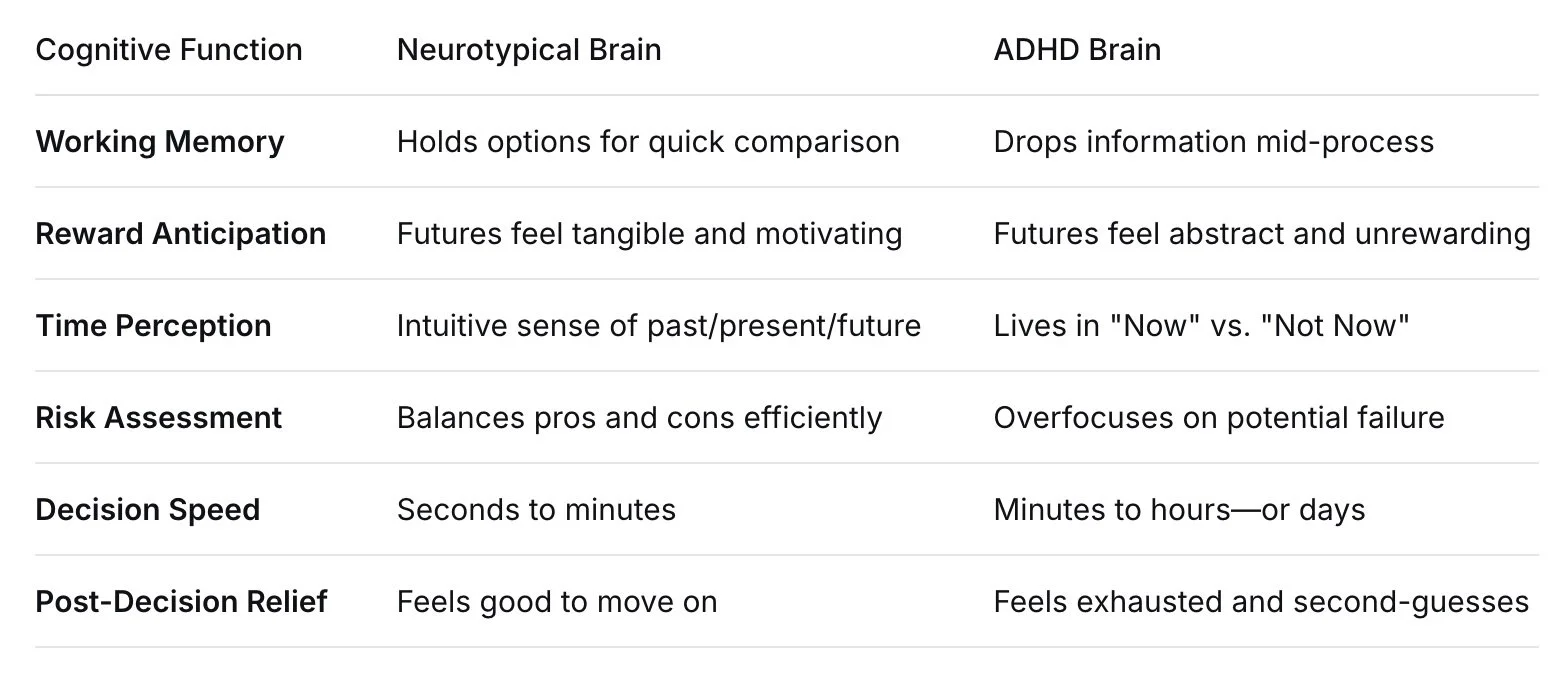
4 Evidence-Based Strategies to Overcome Decision Paralysis
You can start improving your decision-making today. Here are four practical, science-backed strategies we teach at Mind Trek Counseling LLC:
Strategy 1: Automate Routine Decisions
Every decision consumes limited cognitive fuel. Protect your brainpower by automating small choices:
Wardrobe: Wear a "uniform" or pre-select outfits on Sunday.
Meals: Plan the same breakfast and lunch for the workweek.
Bills: Set up automatic payments and subscriptions.
Why it works: You save your decision-making energy for what truly matters.
Strategy 2: Create "Default Rules"
Instead of analyzing each situation from scratch, establish pre-set rules:
"If it's under $50 and I've wanted it for 3 days, I can buy it."
"When unsure between two options, I choose the first one."
"For work, I start with the hardest task first (Eat the Frog)."
Why it works: Rules bypass the overthinking loop and reduce cognitive load.
Strategy 3: Externalize Your Working Memory
Do not rely on your brain to hold all variables. Write it down—but keep it brutally simple:
Draw a T-chart with Pros and Cons.
Limit each side to 3 items maximum.
Then ask: "Which option will make me feel more relieved in 1 hour?"
Why it works: Externalizing frees up working memory and reduces mental fatigue.
Strategy 4: Lower the Emotional Stakes
Perfectionism is the enemy of good decisions. Remind yourself:
Most everyday choices are reversible.
You can return items, change your mind, apologize, or pivot.
A "good enough" decision made now is almost always better than the "perfect" decision made too late.
Why it works: Reducing emotional pressure lowers anxiety and speeds up the decision process.
How Mind Trek Counseling LLC Can Help You
Understanding the why is the first step. But knowledge alone isn't enough—you need a structured, supportive environment to build new habits and rewire old patterns.
At Mind Trek Counseling LLC, we specialize in ADHD therapy for adults across Ohio. Our approach includes:
Psychoeducation: Understand your unique ADHD profile—decision-making, time perception, and emotional regulation.
Cognitive Behavioral Therapy (CBT): Target negative thought patterns ("I always mess up") that fuel avoidance and shame.
Executive Function Coaching: Customized organizational, planning, and decision-making systems that fit your brain—not a generic template.
Medication Coordination: We work alongside your psychiatrist to monitor effectiveness and side effects, ensuring your entire treatment plan is integrated.
Compassionate Accountability: We hold you accountable without judgment—helping you implement strategies consistently and adjust as life changes.
Trauma-Informed Care: Address the emotional wounds from years of feeling broken or lazy, so you can move forward with self-compassion.
📍 Serving All of Ohio—Online and In-Person
Mind Trek Counseling LLC is proud to serve clients throughout the state of Ohio. Whether you're in:
Cleveland
Columbus
Cincinnati
Dayton
Toledo
Akron
Canton
Youngstown
Or any rural or suburban community
We offer secure telehealth sessions so you can access expert ADHD therapy from the comfort of your home—or visit us in person at our Cleveland Heights office.
Our Office Location
Mind Trek Counseling LLC
2460 Fairmount Blvd Suite 209
Cleveland Heights, OH 44106-3125
We accept major insurance plans and offer flexible scheduling for working adults, students, and parents.
Frequently Asked Questions About ADHD and Decision-Making
Q: Why do I freeze on small decisions but handle big decisions under pressure?
A: This is classic ADHD. Big decisions often come with external urgency (deadlines, visible consequences), which triggers hyperfocus. Small decisions have no urgency, so your brain has no motivation to choose.
Q: Is decision paralysis the same as procrastination?
A: Not exactly. Procrastination is delaying action. Decision paralysis is delaying choice because your brain cannot evaluate options efficiently. They often overlap, but they're different mechanisms.
Q: Can therapy really help with something so neurological?
A: Absolutely. While medication addresses the chemical imbalance, therapy rewires behavioral patterns and thought processes. Combined, they are the most effective treatment for ADHD.
Q: Do you offer ADHD testing or diagnosis?
A: Yes. We provide comprehensive ADHD evaluations for adults. Contact us to learn more about the assessment process